The International Monetary Fund (IMF) released its World Economic Outlook in April 2026, forecasting continued growth across most economies — but against an increasingly fragile global backdrop. Escalating conflicts in the Middle East, Eastern Europe, and parts of Africa and Central Asia cast a long shadow over the outlook.
Key Insights from the 2026 Outlook
Key Insight #1 — Growth is not where you might expect
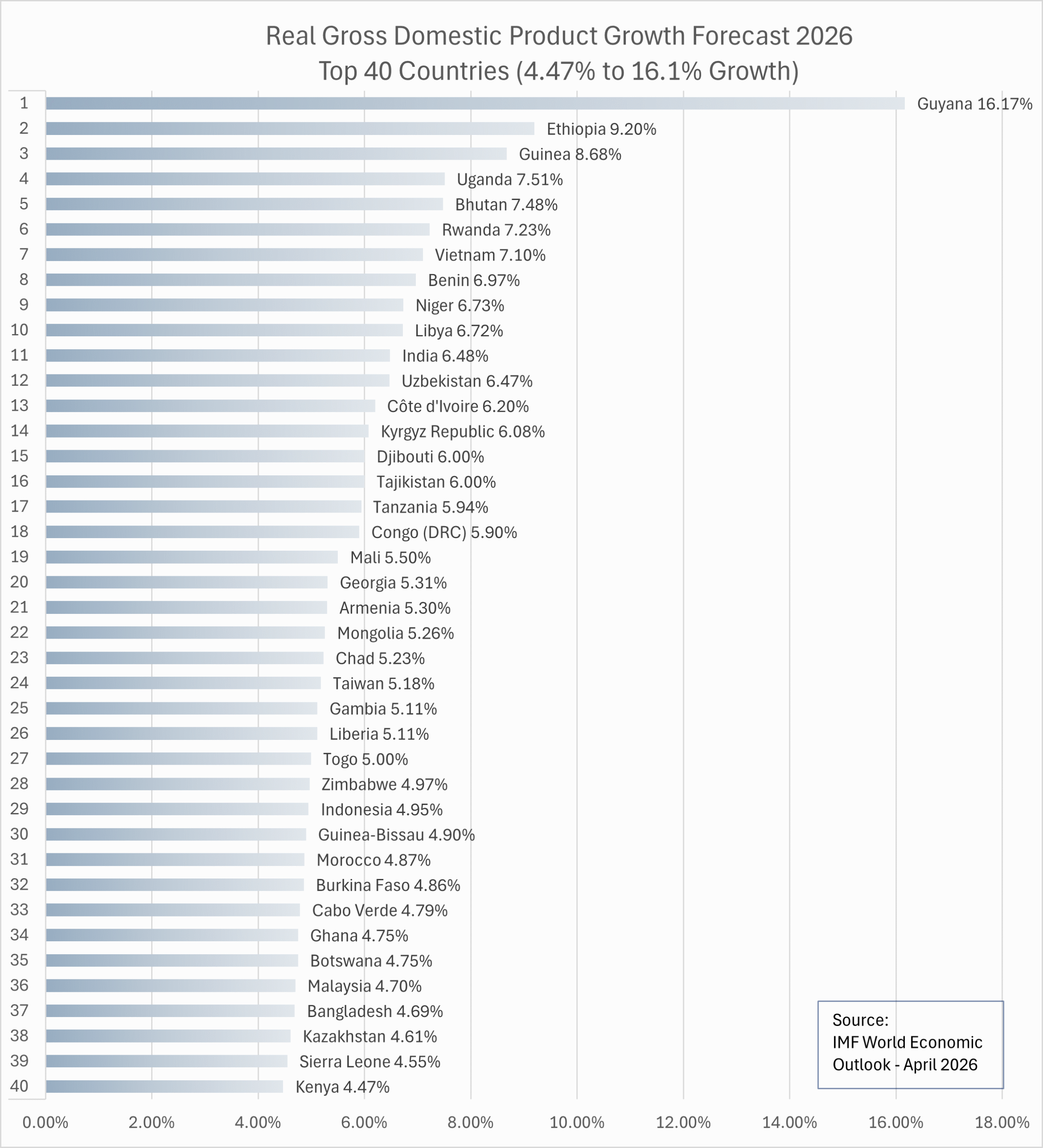
Most of the world’s fastest-growing economies in 2026 are not in Europe or North America, but in Africa and Asia — highlighting a continued shift in global economic momentum toward emerging markets.
Key Insight #2 — A “multi-speed” world is widening
While many economies are expanding, the gap between fast-growing and slow-growing countries is widening. Advanced economies — particularly in the Euro Area — are trailing well behind the global leaders.
Group 1 — 2026 Real GDP Growth Forecast
Fastest-Growing Economies (Ranked 1st–40th)
NOTES
-
The first chart highlights the 40 fastest-growing economies in 2026, concentrated largely in Africa and Asia. Armenia and Georgia stand out as notable European inclusions in this top tier.
-
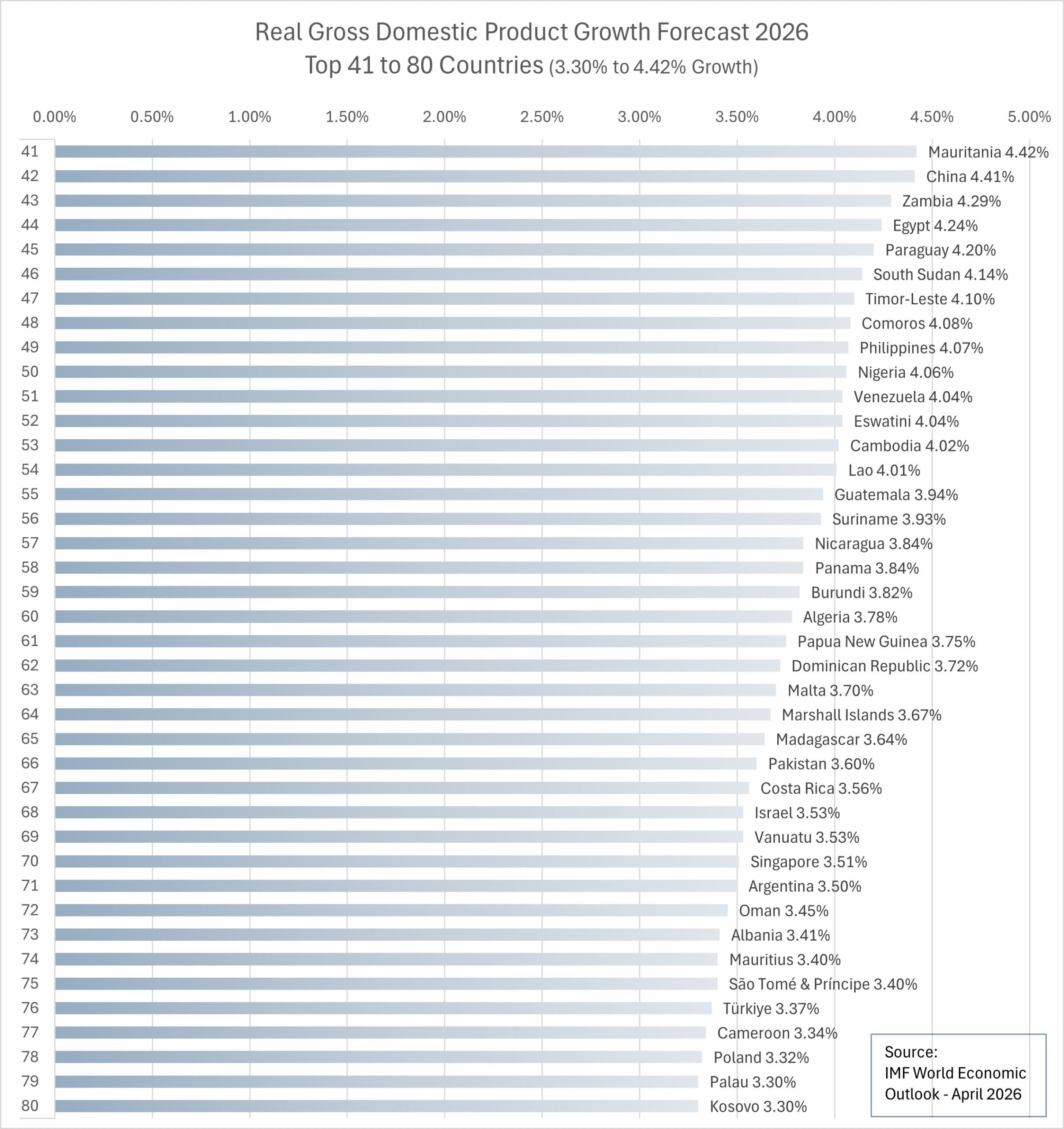
The second chart covers economies ranked 41st–80th by projected growth.
-
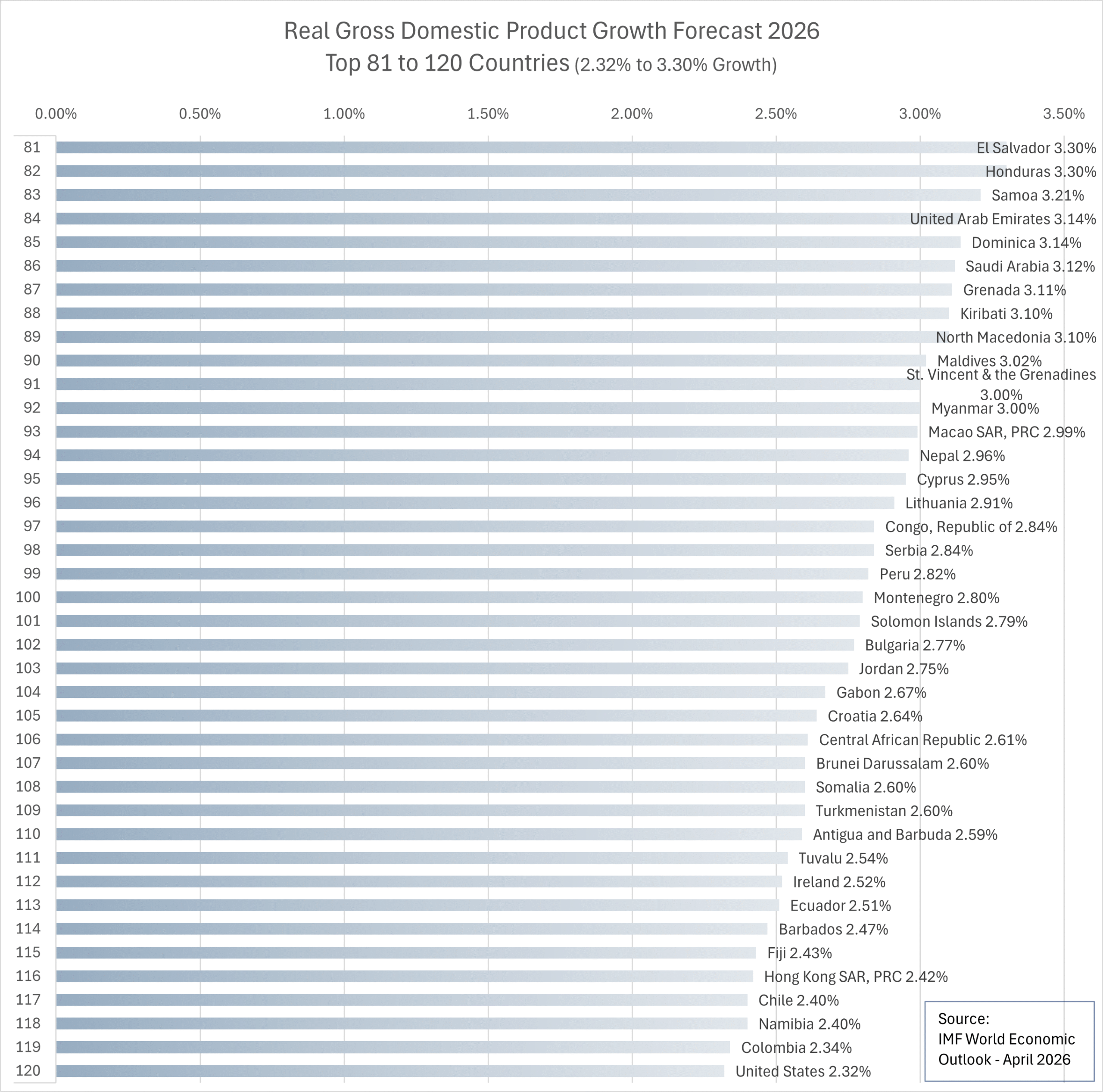
The third chart presents economies ranked 81st–120th.
-
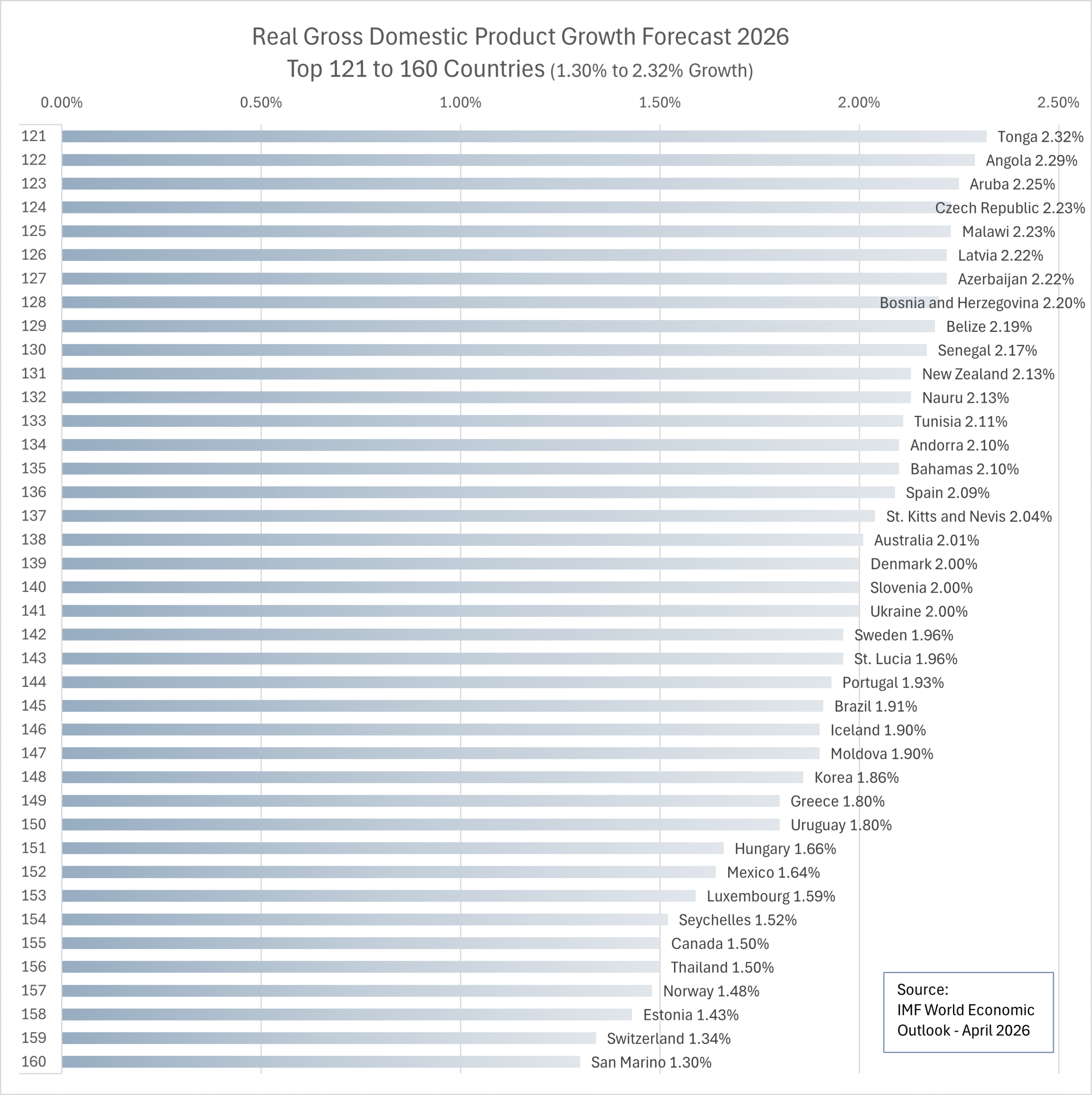
The fourth chart shows economies ranked 121st–160th.
-
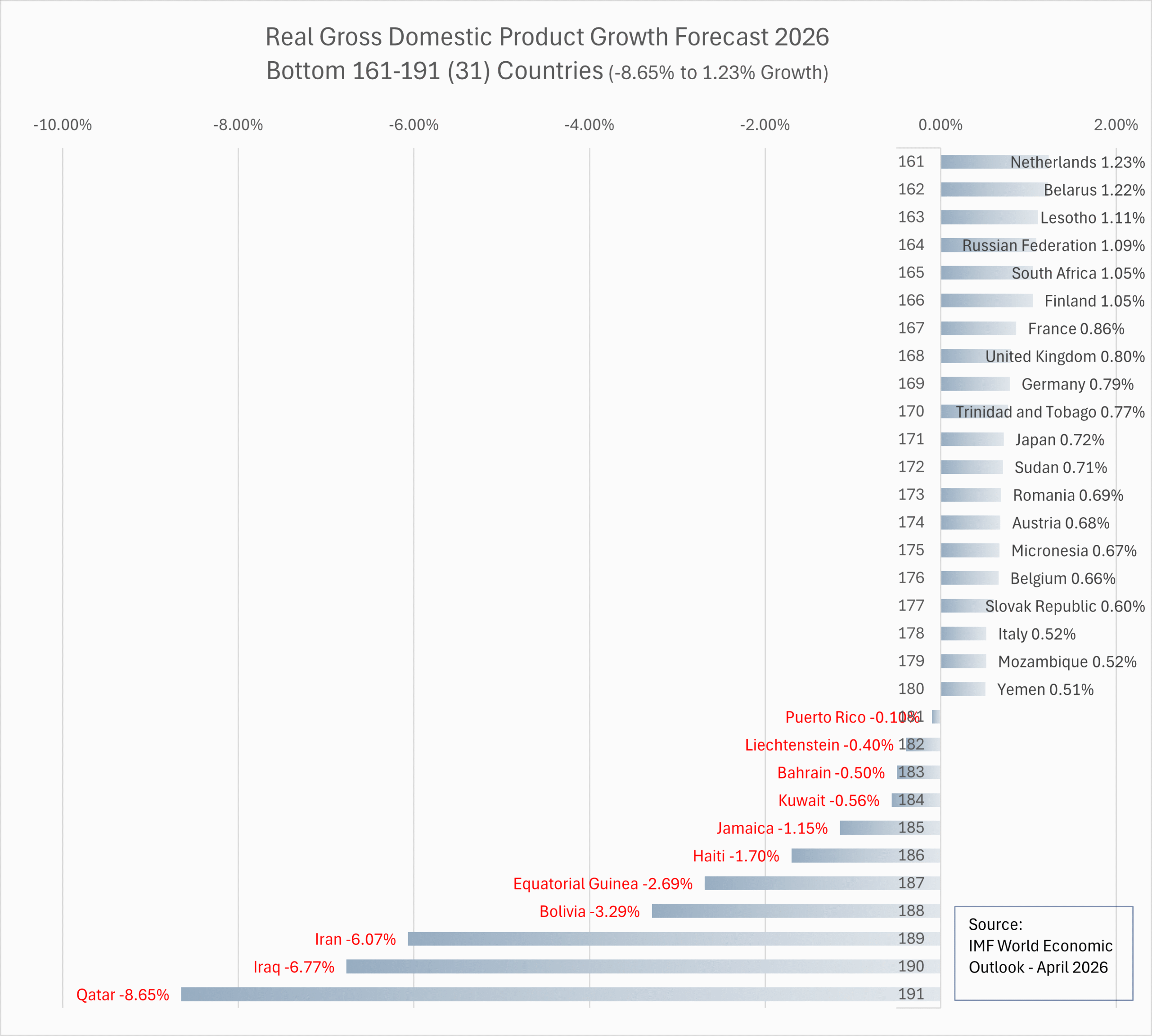
The fifth chart includes the 20 slowest-growing economies (161st–180th), along with 11 shrinking economies: Bahrain, Bolivia, Equatorial Guinea, Haiti, Iran, Iraq, Jamaica, Kuwait, Liechtenstein, Puerto Rico, and Qatar.
-
The sixth chart focuses on the 27 EU member states, revealing a widening divergence. High-growth, service-oriented economies such as Malta contrast with industrial heavyweights like Germany and Italy, which are under pressure from elevated energy costs. Netherlands and Romania have slipped in the rankings, reflecting infrastructure constraints and fiscal tightening, respectively.
- The seventh chart compares major country groups, underscoring the “multi-speed” nature of the global economy. Emerging and Developing Asia leads with growth near 5%, while the Euro Area lags at just over 1%. The European Union (EU-27) outperforms the Euro Area overall, driven by faster-growing non-euro members such as Poland and Czechia, while the Euro Area average is weighed down by slower-growing mature economies including Germany, France, and Italy. Some countries appear in multiple groups due to overlapping classifications.
- Some countries are excluded from these forecasts, typically where reliable data is unavailable.
Group 5 — 2026 Real GDP Growth Forecast
Slowest-Growing and Shrinking Economies
(Ranked 161st–180th + 11 Negative Growth)
Group 6 — 2026 Real GDP Growth Forecast
27 EU Member States
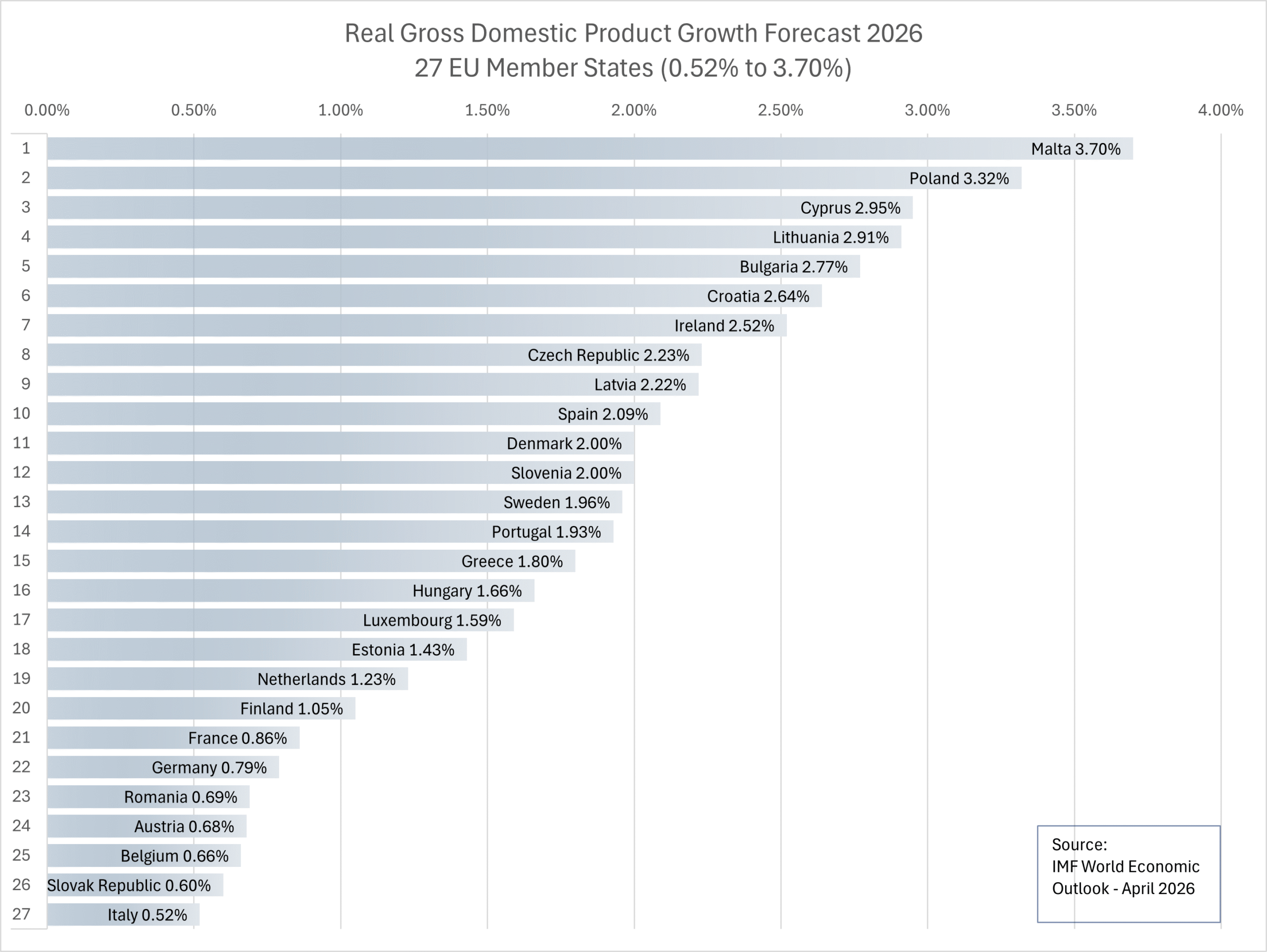
While the EU is projected to grow by a modest 1.34% overall in 2026, several traditionally resilient economies are facing unique “bottlenecks” that have lowered their rankings:
• The Netherlands (19th): The Dutch economy is currently restricted by structural constraints rather than a lack of demand. Key “brakes” on growth include an overloaded electricity grid, strict nitrogen emission regulations that stall construction, and a persistent labour shortage. Additionally, while real wages are rising, high precautionary savings and a loss of external competitiveness due to energy costs have dampened the outlook. Source: ABN•AMRO, Rabobank
• Romania (23rd): Once a regional growth leader, Romania’s forecast was significantly revised downward to 0.69%. This reflects the heavy impact of fiscal consolidation—specifically tax increases and public sector wage freezes—necessary to address its large budget deficit. High inflation and rising labour costs have also eroded the country’s export competitiveness in the near term. Source: European Commission
• Germany (22nd) & Italy (27th): These major industrial hubs continue to struggle with the energy-driven supply shock linked to the war in the Middle East. Their high reliance on energy-intensive manufacturing makes them more vulnerable to the price volatility and shipping disruptions currently affecting global trade routes like the Strait of Hormuz.
Source: IMF
• Ireland (7th): Ireland remains a top-tier performer, though it has stabilized from previous “hyper-growth” years. Its ranking is still heavily influenced by the accounting of multinational corporations, which can sometimes mask the underlying performance of the domestic economy.
Source: Euronews
Group 7 — 2026 Real GDP Growth Forecast
Country Groups
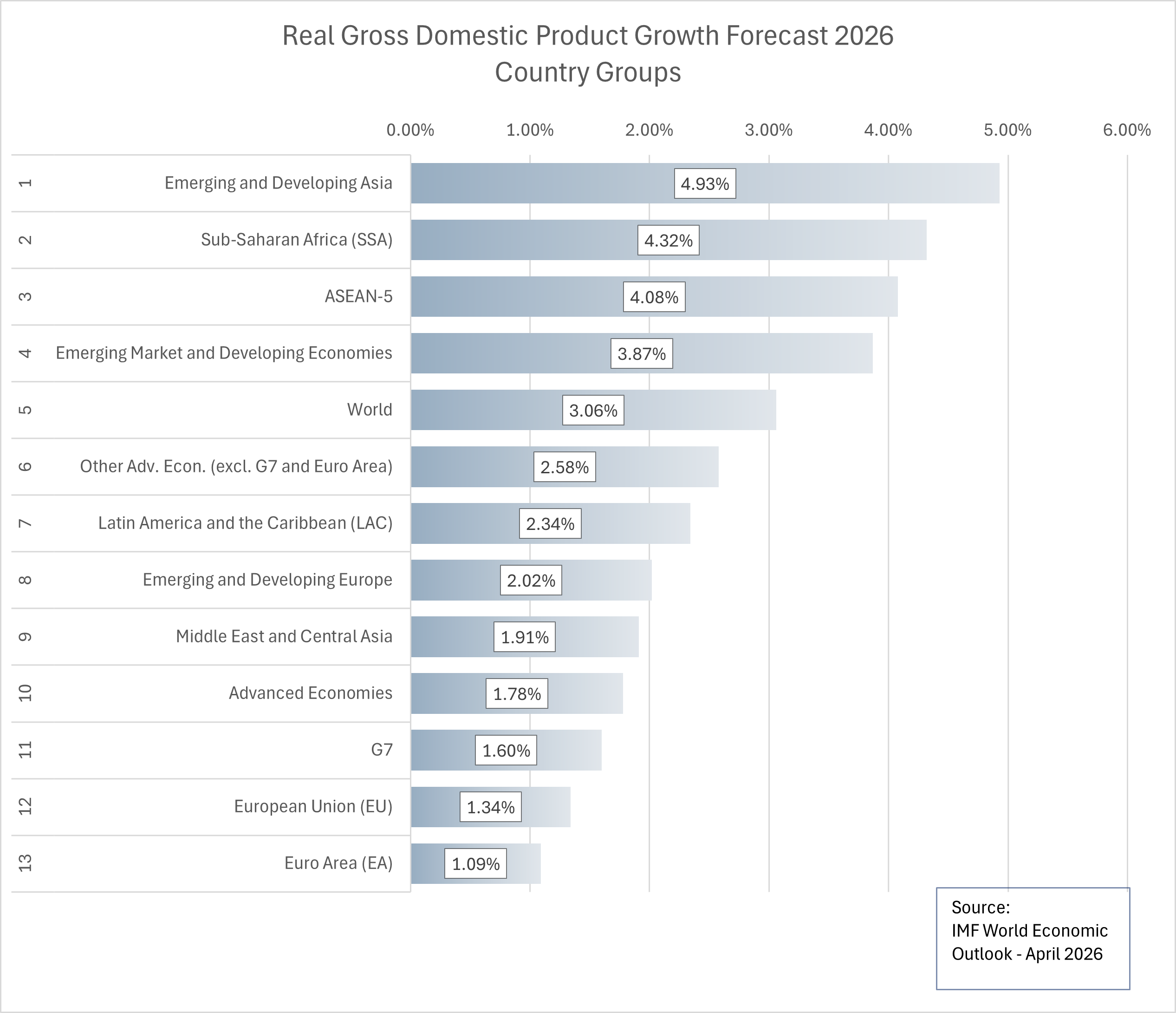
• The Growth Leaders: Emerging and Developing Asia continues to be the primary engine of global growth at 4.93%, followed closely by Sub-Saharan Africa (4.32%). The ASEAN-5 (Indonesia, Malaysia, Philippines, Singapore, and Thailand) also shows strong resilience at 4.08%.
• The Global Average: The World growth forecast of 3.06% serves as the benchmark. Any group above this (Groups 1–4) is outperforming the global average, while any below (Groups 6–13) is underperforming relative to the world mean.
• The “Slow Lane”: The lowest growth is concentrated in the Euro Area (1.09%) and the European Union (1.34%). This indicates that the broader European region is expected to grow at roughly one-quarter the speed of Developing Asia in 2026.
• Advanced Economy Divergence: Interestingly, “Other Advanced Economies” (which includes nations like South Korea, Taiwan, and Australia) are projected to grow significantly faster (2.58%) than the G7 nations (1.60%).
Summary
The International Monetary Fund (IMF) published its World Economic Outlook in April 2026, projecting global growth of around 3.1% for the year. While most economies are expected to expand, the outlook reflects an increasingly uneven and uncertain global environment.
Growth remains highly uneven across regions, with emerging and developing economies significantly outperforming advanced economies—helping explain why many of the fastest-growing countries are concentrated in Africa and Asia.
At the same time, the global economy faces mounting risks. Escalating conflicts in the Middle East, Eastern Europe, and parts of Africa and Central Asia are driving higher energy prices and increasing volatility. The IMF notes that outcomes could vary widely depending on how these conflicts evolve, with more severe scenarios pointing to weaker growth and higher inflation.
Slowing global trade and persistent structural pressures — particularly in energy-importing and industrial economies — further contribute to what is increasingly described as a “multi-speed” global economy in 2026.
Lower growth in the Euro Area than in the EU as a whole
It is a common misconception that the non-euro countries in the European Union (EU-27) are primarily the “catch-up” economies. In reality, the 2026 forecast shows that the Euro Area is expected to grow more slowly than the European Union as a whole — 1.09% vs. 1.34%.
This discrepancy is driven by several fascinating factors:
- The “High-Growth” Non-Euro Group
As of January 1, 2026, the Euro Area consists of 21 countries, with Bulgaria being the latest member. This leaves only 6 countries in the EU that do not use the euro (the Non-Euro group):- The “Wealthy Outsiders”: Denmark and Sweden.
These are “rich” nations that chose to keep their own currencies. Because they have more independent control over their interest rates and currency values, they often have more flexibility to respond to economic shocks. - The “Growth Engines”: Poland, Czechia, Hungary, and Romania.
These four countries are still in a “catching up” phase and typically grow much faster than mature economies like France or Germany. By remaining outside the Euro Area, their higher growth rates are excluded from the Euro Area average but included in the EU-27 total.
- The “Wealthy Outsiders”: Denmark and Sweden.
- The Weight of the “Core”
The Euro Area is dominated by the G7 European “heavyweights” — Germany, France, and Italy. In 2026, these countries are projected to have some of the lowest growth in the world (0.52% to 0.86%) due to high energy costs and structural industrial shifts. Because they represent the vast majority of the Euro Area’s economy, their slow growth pulls the entire group’s average down. - Economic “Maturity”
Advanced, “rich” economies generally grow more slowly than developing ones. They have already built their major infrastructure and reached high levels of productivity, so their gains are incremental (often around 1–2%). In contrast, the “faster-growing” countries in the Group 1 chart are starting from a lower base, where new investments lead to much larger percentage gains.